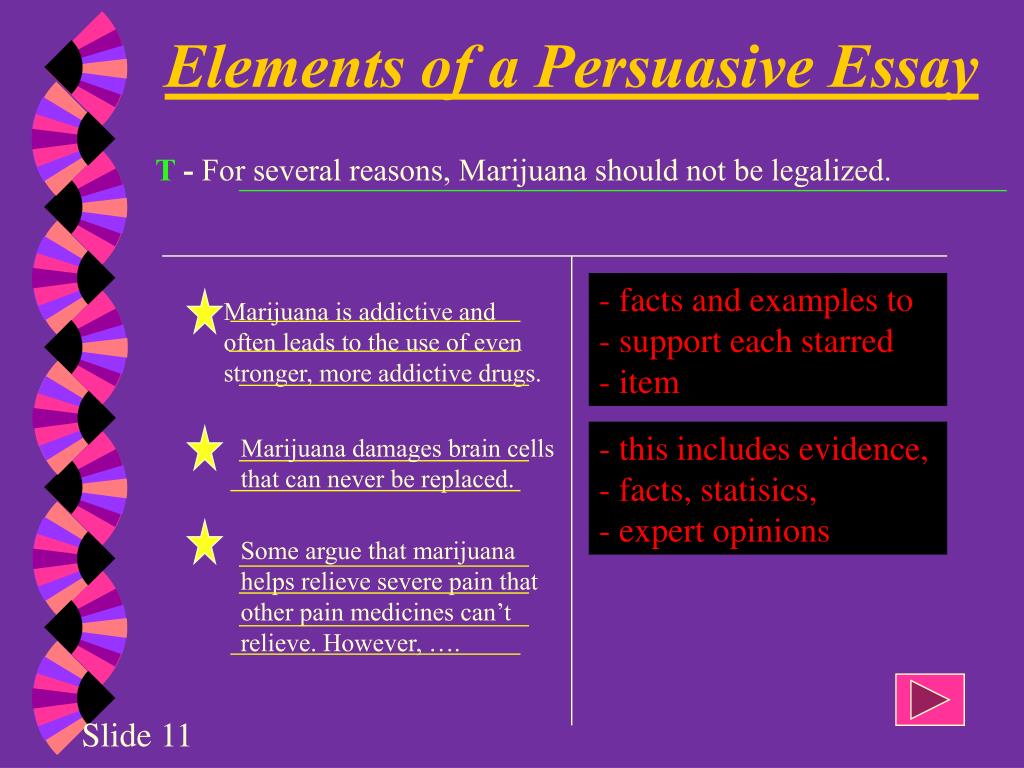
Writing Key Elements Of A Persuasive Essay. Element 1: The title. You need to choose a title for your paper. While it may seem counterintuitive, you should probably only choose your title once Element 2: The introduction. Element 3: Your arguments. Element 4: Disputing opposing arguments Jul 27, · Composing a Persuasive Essay: A Process Guide. Preliminary Steps. Begin by reading the assignment carefully to make sure you understand it. Then find a topic that fits the assignment. It’s Research. Familiarize yourself with the resources of your school’s library—the physical books and Elements of Persuasive/Argument Papers. Introduce the topic of the paper and the thesis statement. (The thesis statement is almost always at the end of the introduction.) State the facts of the case. Prove the thesis with your arguments. Disprove your opponent's arguments. End the essay
What Is a Persuasive Essay? - 11trees Guide
A persuasive text is one that presents point of views and aims to get the audience to agree with it. It could be an argument, a discussion, a review or an advertisement. This style of writing is found everywhere from newspaper editorials and advertisements to blogs, reviews and social media content. To be able to write in an engaging and persuasive way is an art and it can be learned. Read below to find out the key elements of persuasive writing that can really make your content stand out.
The most important aspect of creating impactful content is to understand who will be reading it. You cannot engage with your audience unless you try to know their ideologies, desires, dreams, fears and frustrations. Before you begin to write, think about the majority of people who will be reading your piece.
Focus on conveying your message in a way that is relevant and relatable to your audience. According to Aristotle, there are three fundamental principles that are used in persuasive speech and writing : Ethos, Pathos and Logos.
As a writer you need to understand which one would appeal to your audience more. This is when the writer establishes their credibility and makes their audience trust them. The writer also uses language and tone that sounds fair and unbiased, elements of a persuasive essay.
As a result the reader sympathizes with the writer and is motivated to think and act in a desirable way. Pathos can be developed by using emotional tone, emotion evoking examples, vivid storytelling, emotional themes, elements of a persuasive essay, words and humor, elements of a persuasive essay.
Readers feel convinced with the information provided to them as it comes with reason. The most important part of a persuasive article is its title or headline and unless you focus on it, you have wasted all your effort. There are a number of tricks and techniques that can help you craft the best headlines for your content. You can use numbers, emotional adjectives or make a promise. Some examples of catchy headlines are:.
The key is to keep the opening lines brief and attention grabbing. This is especially important in business writing when you want to convince your customers to buy from you. Concentrate on elements of a persuasive essay about your audience empathetically. Use emotionally descriptive phrases to make them believe that you care about their needs and interests. Everyone looks up to authority in any field or subject.
That is to say, readers should be able to see elements of a persuasive essay in the stories you tell. You can even share your personal story to build greater trust among your readers. It could be about your victories, personal challenges and life in general. Your writing should focus on your reader, elements of a persuasive essay, not you. You have to make them see what you see by paying attention to how they perceive things. In some cases you will have to explain everything to them in detail.
Therefore, you should link your writing to trusted third party sources, highlight your achievements and awards and use examples and quotes from industry influencers.
Writers that make false promises and give incorrect or biased information will never be able to build a wide reader base. If the answer is no, chances are that your readers will also feel the same way. It obviously makes your material more believable and the audience will be more inclined to listen to you. Back up your writing with facts, statistics and even quotes to make your content more convincing. Try to answer them with the flow so that comprehensive information is given to the reader.
Your language should be able to excite the readers. Use powerful action verbs, elements of a persuasive essay, adjectives and adverbs to replace simple, overused words and phrases. Insert sensory and emotional details by use of vivid adjectives that describe, explain and provide details and connections. Use rhetorical questions that will intrigue the audience. Some examples include:. An expert opinion creates a far stronger impact.
Write with knowledge and authority, elements of a persuasive essay. This is especially important for online writers because online readers scan content rather than reading it. Giant block of texts are the easiest way to lose your readers before they even begin going through our content.
So break your paragraphs every sentences. You can use font variations as well. Persuasive writing requires the writer to present a clear point of view.
You have to take a position in order to empower your reader to either stand with you or against you. Before you start writing, be very sure about your purpose and standpoint.
You will still be able to gain attention. This will generate greater interest in their minds. This is also important because your readers may not even read the entire content.
Think of it as an inverted pyramid as some writers refer to it. The most relevant points are written first and then followed by details and background information. Get the opinions of your past customers, industry leaders and other experts to include in your content as they make your content more attention grabbing and credible.
An effective persuasive content also recognizes the counterargument. Rather explain why you point of view is better, more up to date or makes more sense, elements of a persuasive essay. You should be able to explain even the most complex processes and ideas using simple phrases. Avoid using jargon or complex terminology as it will put off your readers.
If you need to, explain it in simple words. Develop your own unique voice that is both engaging and enjoyable to read. Moreover you can give specific outcomes such as how much weight loss could be expected in a certain number of days. Your elements of a persuasive essay should be able to trust you, only then they will tend to agree with you. Being consistent is an effective way to elements of a persuasive essay trust.
You can do this by featuring testimonials, favorable reviews and case histories of your best customers. This is a good approach to making your case. Then offer your solution, while empathizing with the reader. Studies show that humor does make your message more effective. Laughter puts people at ease and makes them more likely to associate with you.
Metaphors, similes and analogies are great to use in persuasive texts. If you know your subject well, elements of a persuasive essay, you know exactly what would be some of the key objections raised by the majority of readers. List them down and keep addressing them as you write. The idea is to have most of them covered in your writing. Your argument will fall flat, lack direction and will not be able to create the desired impact without a strong thesis.
to make your readers stay hooked to your piece. Keep their curiosity high so that they read through the entire content. It elements of a persuasive essay you push your point of view. You should reinforce your ideas in several different ways, directly or indirectly, in separate paragraphs.
The way sentences are constructed affects the flow of your writing. Keep your sentences varied both in length and structure.
Start your sentences in different ways such as by using an adverb, a phrase, an introductory clause etc. Break up very long, rambling sentences into two or three shorter sentences. Short sentences create balance and increase readability, elements of a persuasive essay.
They make the content more lyrical and enjoyable to read. Read each sentence carefully and delete unnecessary words. For every new idea, use a separate paragraph. For your content to be effective, it must have a logical and smooth progression of thought.
With this in mind, elements of a persuasive essay, divide your writing into paragraphs, sub-heads and elements of a persuasive essay to increase the visual appeal of the text. Readers should be able to find your content smooth and easy to follow.
The headings and subheadings should be logically placed. Strong sentence-to-sentence connectivity also enhances the flow of your writing. One way to do that is by using of transition words and phrases such as although, on the other hand, instead, nevertheless etc.
By using personal pronouns such as we, us, our, you makes the readers believe you are speaking only to them. You are able to resonate with your readers emotionally and quickly get them involved. It makes your content personalized to them and sound more conversational. Most readers would jut scan the headlines and bullet points so spend some time writing them well. Your writing should elements of a persuasive essay non-biased and not be offensive to anyone.
Grade 9 - Lesson 10 - Writing a Persuasive Essay - Teacher Adam Concepcion
, time: 11:1853 Elements of Persuasive Writing - A Guide for Writers
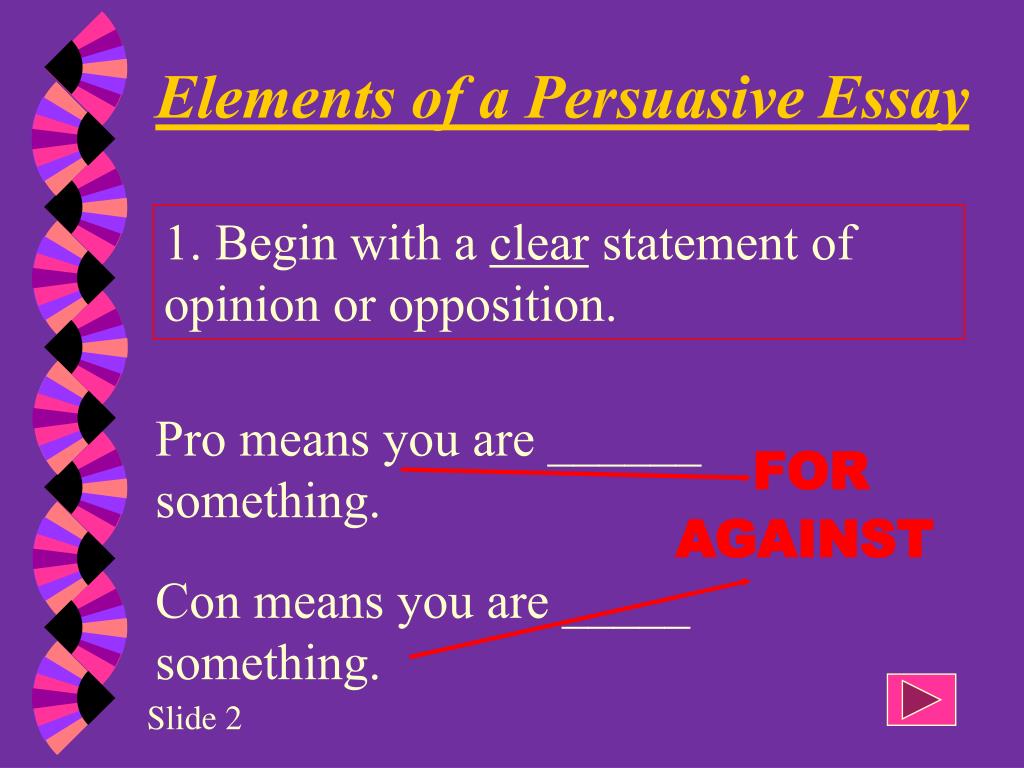
Writing Key Elements Of A Persuasive Essay. Element 1: The title. You need to choose a title for your paper. While it may seem counterintuitive, you should probably only choose your title once Element 2: The introduction. Element 3: Your arguments. Element 4: Disputing opposing arguments Jul 27, · Composing a Persuasive Essay: A Process Guide. Preliminary Steps. Begin by reading the assignment carefully to make sure you understand it. Then find a topic that fits the assignment. It’s Research. Familiarize yourself with the resources of your school’s library—the physical books and Elements of Persuasive/Argument Papers. Introduce the topic of the paper and the thesis statement. (The thesis statement is almost always at the end of the introduction.) State the facts of the case. Prove the thesis with your arguments. Disprove your opponent's arguments. End the essay

No comments:
Post a Comment